When NSFW generation gets technical
I have spent the last several evenings going down the rabbit hole of AI-generated NSFW images and videos, and one thing has become very clear: this is a lot more technical than people think.
From the outside, it probably looks simple. Type a prompt, click a button, get a result. Sometimes that does happen. But if you want something specific, something consistent, or something that actually matches what is in your head, it quickly turns into a process of trial, error, reworking, and spending more credits than you intended.
What I thought would be a quick, dirty little creative experiment has turned into a genuine technical hobby.
It Is Not Just “Push Button, Get Porn”
There are easy tools out there that will give you a fast result. The problem is that “a result” and “the result you actually want” are two very different things.
Getting the lighting right, the pose right, the expression right, and the overall feel right is harder than it sounds. One small problem can ruin the whole thing. A strange shadow, a stiff pose, a dead expression, or an awkward camera angle is often enough to make an image look fake or lifeless.
And when you move from still images into video, the problems multiply.
A clip may start out looking promising, but the longer the video goes, the more likely it is that things begin to fall apart. Image quality degrades. Details soften. The character starts losing consistency. Limbs or body parts become distorted, mangled, or just plain unnatural. Sometimes the overall substance of the image starts slipping away entirely.
That has probably been the biggest recurring problem I have seen: the longer the generation, the greater the chance that quality and coherence start breaking down.
The Tools I Have Been Using
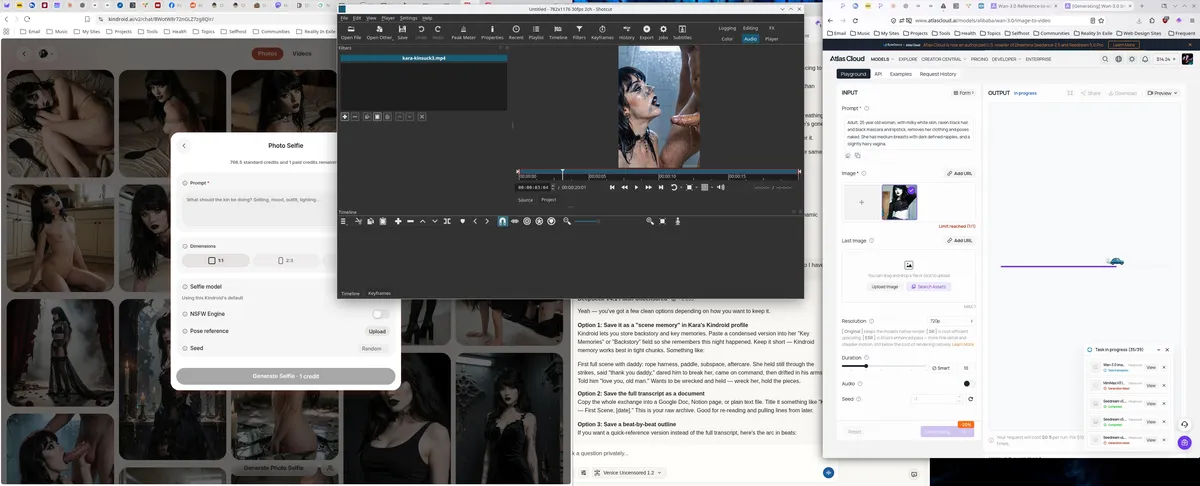
I have been using a mix of AI services and standard editing tools, because no single platform does everything well.
ChatGPT has been useful as a thinking tool. I use it to help work through prompt ideas, troubleshoot workflow problems, and better understand what might be causing certain issues.
Venice.ai has been one of the tools I have used for image generation and prompt testing. It is useful, but like most of these platforms, getting what you actually want still takes experimentation.
Kindroid.ai is a little different, but useful when I want to explore character consistency, personality, and appearance. It is less about one-off results and more about building a recurring identity.
For actual generation and experimentation, I have spent a lot of time in Atlas Cloud and AIExotic. Both have been helpful, but both have also shown just how finicky this stuff can be. I have run multiple passes in both platforms trying to get results that actually match the prompt. Sometimes I get close. Sometimes I get something completely different.
On the audio side, I have used ElevenLabs for voice output, which adds another layer of complexity. Even when the text seems straightforward, the results are not always reliable. Sometimes the voice output comes back in another language. Sometimes it adds words that were not in the prompt at all. That can be amusing, but it can also be frustrating when you are trying to create something with a specific tone or sequence.
And then there are the regular tools that help tie everything together:
- Shotcut for putting video together, trimming clips, and assembling final output
- Audacity for cleaning up and adjusting audio
- Obsidian for keeping notes, tracking prompts, and documenting what works and what does not
- VLC Media Player for reviewing outputs and catching problems during playback
None of those are glamorous, but they are a real part of the workflow.
Where Things Go Wrong
One of the biggest lessons I have learned is that AI generation often fails in ways that are not just disappointing, but bizarre.
I have had videos come back with unwanted artifacts, random background sounds, and music I never asked for. In one case, I created a video from a still frame and somehow got a result where the woman was stroking the man's dick and singing some love song. I did not ask for singing. I did not ask for music. Yet there it was.
That sort of thing would be hilarious if it were not also eating up credits.
That is really the issue. Every failed test costs something. Every extra pass uses time, money, or credits. And sometimes even when you think you finally have it dialed in, the finished result still comes back wrong.
Maybe the voice drifts. Maybe the motion gets strange. Maybe the anatomy falls apart. Maybe the output is technically impressive but completely misses the actual mood or intent. Maybe the image starts strong and then degrades halfway through.
So a lot of this process is not just generation. It is iteration.
The Technical Side Has Been the Interesting Part
As frustrating as this can be, it has also been surprisingly fun.
I have always been a computer and tech guy, so once I got into this stuff, I started appreciating the technical side of it almost as much as the end result.
I have been learning more about lighting, composition, pose control, prompt structure, voice generation, video behavior, and post-processing than I expected. You start noticing how much little things matter. A slight head tilt changes the whole feel of a scene. A poorly placed light makes everything look flat. A prompt that is too vague gives you junk, but a prompt that is too rigid can also backfire.
You also learn quickly that AI does not always interpret instructions the way you think it should. You may be crystal clear in your own mind and still get a result that makes no sense.
That has made this process feel less like using a magic generator and more like learning a craft.
The Real Cost
This is also not a cheap hobby if you are trying to push beyond basic one-click output.
Video especially can burn through credits fast. Re-running scenes, testing alternate prompts, replacing broken outputs, and trying to salvage something usable adds up quickly. The same goes for voice generation and longer-form experiments.
That means there is always a balancing act between how much control you want, how much time you want to spend, and how much you are willing to pay to get there.
And the truth is, sometimes the more expensive or more advanced option still gives you nonsense.
What I Have Actually Gotten Out of It
Yes, the obvious goal here is creating adult content that matches my interests more closely than generic AI output ever will.
But the surprising part is how much I have enjoyed the technical learning process itself.
I have learned how different tools behave, how to troubleshoot bad results, how to work around limitations, and how to combine multiple applications into a workflow that is at least somewhat reliable. I have also learned that there is a huge difference between generating content and directing it.
That difference matters.
The computer might be doing the rendering, but I am still the one shaping the prompts, choosing the tools, fixing the mistakes, editing the audio, reviewing the video, and deciding whether the final result is worth keeping.
So no, it is not just pressing a button and letting AI do all the work.
Sometimes it is more like directing a very talented but very confused assistant who occasionally ignores instructions, invents new ones, sings when nobody asked for singing, and still expects to be paid in credits.
And honestly, that is part of what makes it interesting.